Adaptable hardware
Bring heterogeneous, affordable gas sensors into a shared experimental sensing platform.
[ Sensing / Connected systems ]
From an unfamiliar air sample to a recognisable pattern: sensing, calibration, and AI-assisted analysis.
Read the Sensors paper (opens in a new tab)THE IDEA, IN MOTION
An unfamiliar sample enters a controlled chamber. A pump brings the sample across several gas sensors, just as a laboratory instrument would.
A visual explanation of the research process. Illustrative signals and movement; no measured results are shown.
[ 01 / The context ]
Two air samples can look identical yet contain different chemical mixtures. An electronic nose makes those differences available to study: several sensors respond to a sample, and their combined pattern acts like a fingerprint. This collaborative research develops an adaptable laboratory platform for capturing those responses and exploring how they can be interpreted.
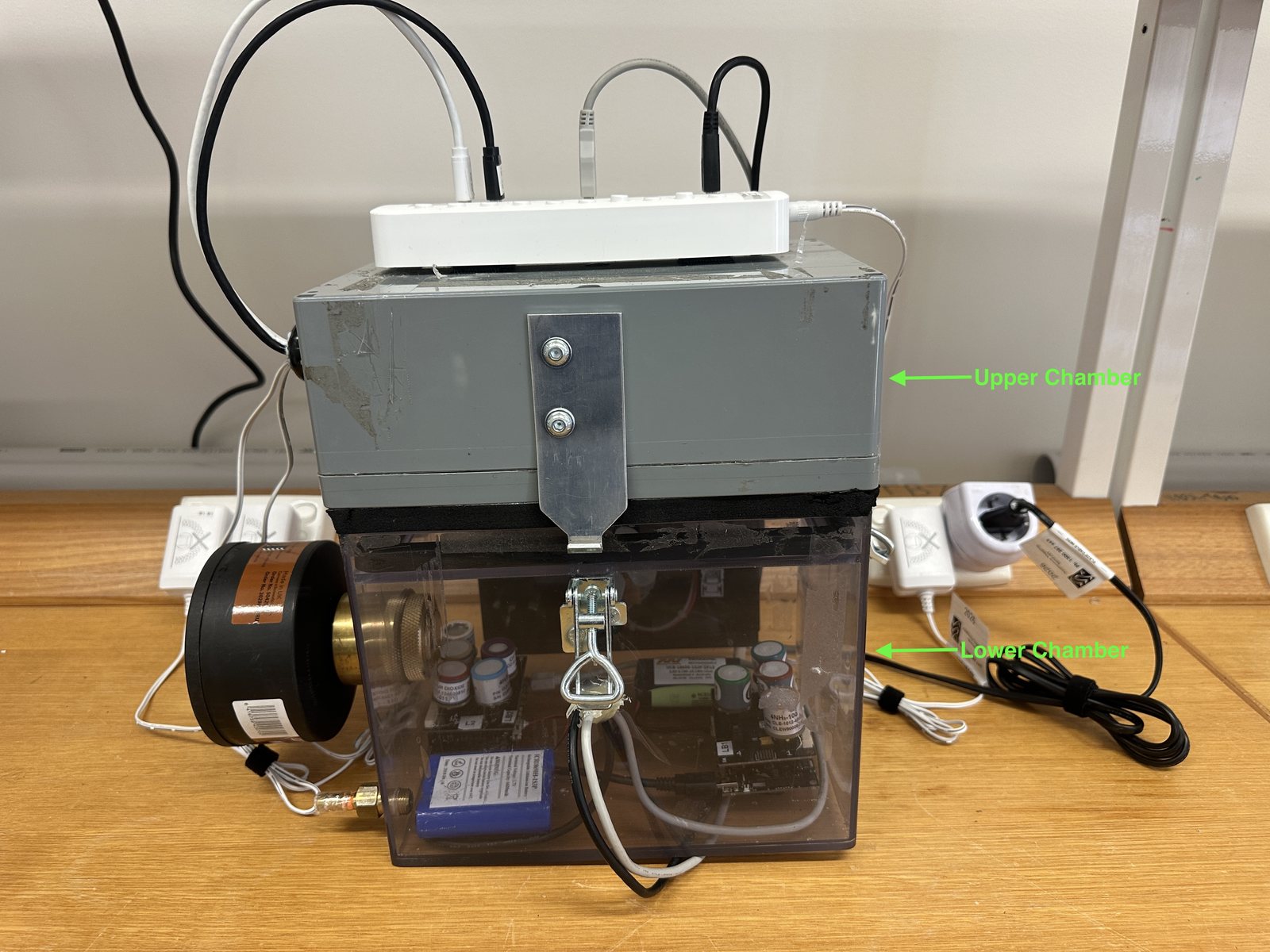
The 2026 Sensors article, Adaptive E-Nose: Integrating New Gas Sensors for Emerging Applications, documents the adaptable sensing platform. The laboratory setup combines a sensor array, experimental chambers and a data pipeline. The animation extends that workflow into an AI research concept: calibrate the signals, compare their collective fingerprint, and investigate classification models rather than relying on one sensor reading.
Bring heterogeneous, affordable gas sensors into a shared experimental sensing platform.
Capture and process multi-sensor responses, supported by a laboratory data-acquisition workflow.
Explore how calibrated response patterns could support machine-learning classification, with uncertainty and experimental validation kept in view.
[ 02 / Research scope ]
The published work describes a laboratory sensing and acquisition platform. AI classification in this visual is a research direction, not a validated identification result. No detection accuracy or operational capability is implied.
Hardware photographs from the Adaptive E-Nose research project.